
Why Gen Z Is So Anxious
This generation has a problem. Gen Z, more than any past generation, is anxious about life, school, work, love, you name it. It seems like there's some misconception, though, that this is just a trend or quirk, but it is actually a much deeper problem than that.
Take a look at this graph.
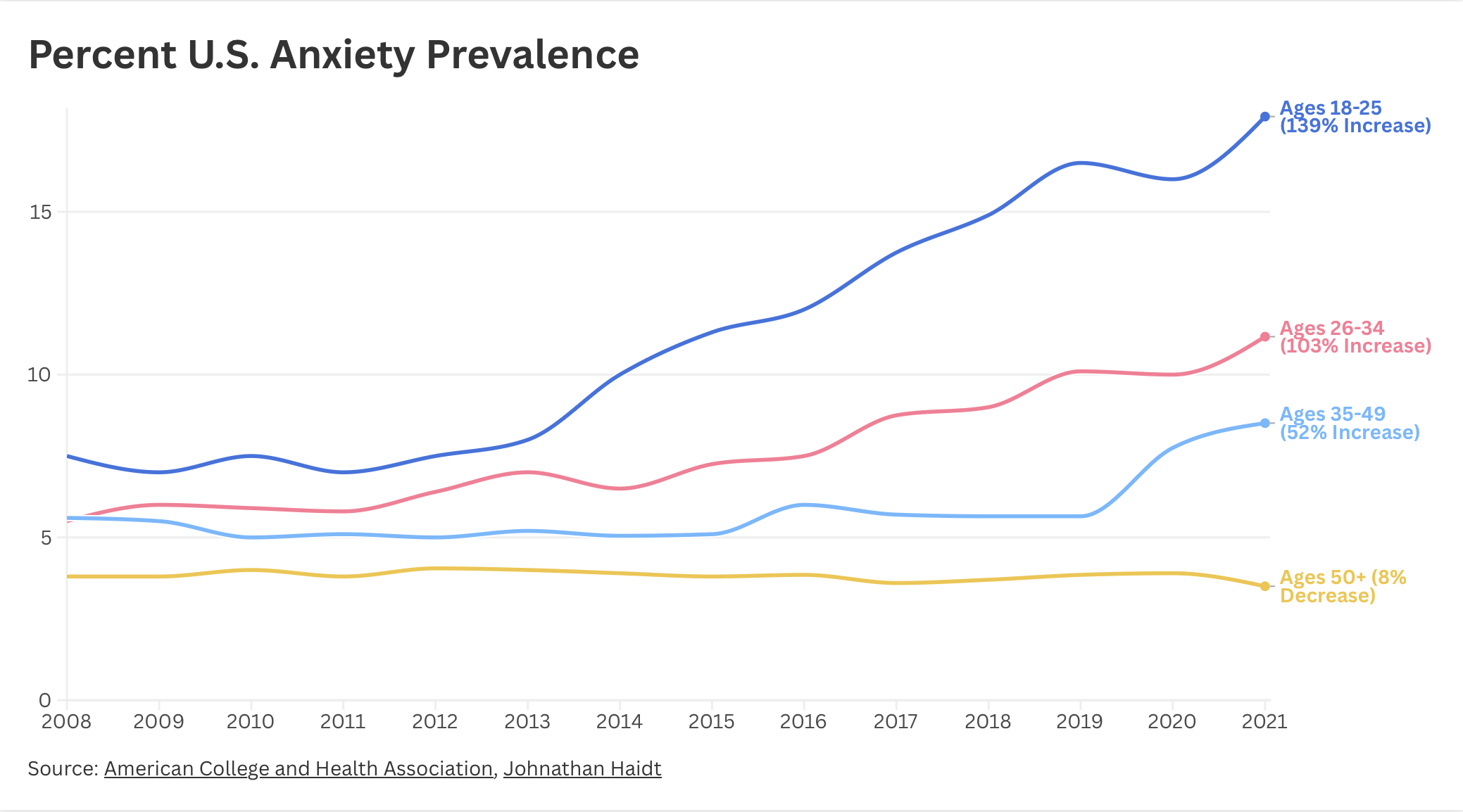
It shows the increase of anxiety in Americans over the past 30 years. See that sharp incline? Among Americans aged 18–25, the rate of anxiety has jumped from roughly 7.5% in 2008 to nearly 18% by 2021. That means nearly 1 in 5 young adults are living with clinically significant anxiety. It’s a quirk, it’s a trend. A generational shift. Something is happening, and we’re the ones feeling it.
But here’s the thing: we didn’t cause this. We’re reacting to it. And this isn’t a by-product of COVID. It began long before 2020, around the time smartphones and social media exploded.
After 2012, things shifted. Social media stopped being a fun distraction and started becoming the town square. We weren’t just using our phones: we were living through them. These apps are built to keep you hooked through a feedback loop of likes, views, streaks, shares. That loop changes your brain. Every notification is a maybe. Maybe someone liked your post. Maybe someone texted back. That ‘maybe’ is what triggers dopamine, the chemical that makes habits stick.
We become addicted to these apps, searching for a dopamine high, searching for validation, and becoming jealous of others who have what we want. According to UC Davis Health, in 2023, there were an estimated 4.9 billion social media users worldwide. The average person spends about two and a half hours on social media a day with some estimates placing teens at 4 hours per day on average.
Gen Z and Millennials were released into the internet without any way of knowing how critical it would become in our lives, and it has done significant damage.
The American Academy of Family Physicians found that 46% of American teens reported “having experienced at least one form of cyberbullying, such as offensive name-calling (32%), spreading of false rumors about them (22%), receiving explicit images they didn’t ask for (17%), constantly being asked where they are, what they are doing or who they are with by someone other than a parent (15%), physical threats (10%) and having explicit images of them shared without their consent (7%).”
There are countless ways to be victimized online, whether by other people or by the algorithm, and teens are always hooked to it.
There’s also the fact that everything just feels… heavier. It’s hard to manage your anxiety when your feed is a pipeline of panic, growing up with lockdown drills as a norm. Wildfires. Global pandemics. Political chaos. And we’re not just seeing it, but we’re seeing it all the time. It’s not that Gen Z is more sensitive. It’s that we’ve grown up constantly absorbing crisis after crisis, without time to process the last one before the next hits.
There’s this pressure to stay informed, speak out, care about everything. And unlike past generations, we don’t get to look away. Our phones make the world feel smaller, but also scarier. The climate crisis isn’t some far-off thing. Neither is political violence. We see it up close. Every day. And often alone. That heaviness builds up. It doesn’t always look like panic–it can look like numbness, like burnout, like checking out. But it’s there. In our nervous systems, in our group chats, in how we talk, or how we don’t. This isn’t just personal struggle. It’s collective stress. And we’ve been absorbing it for years.
But here’s what makes younger generations different:
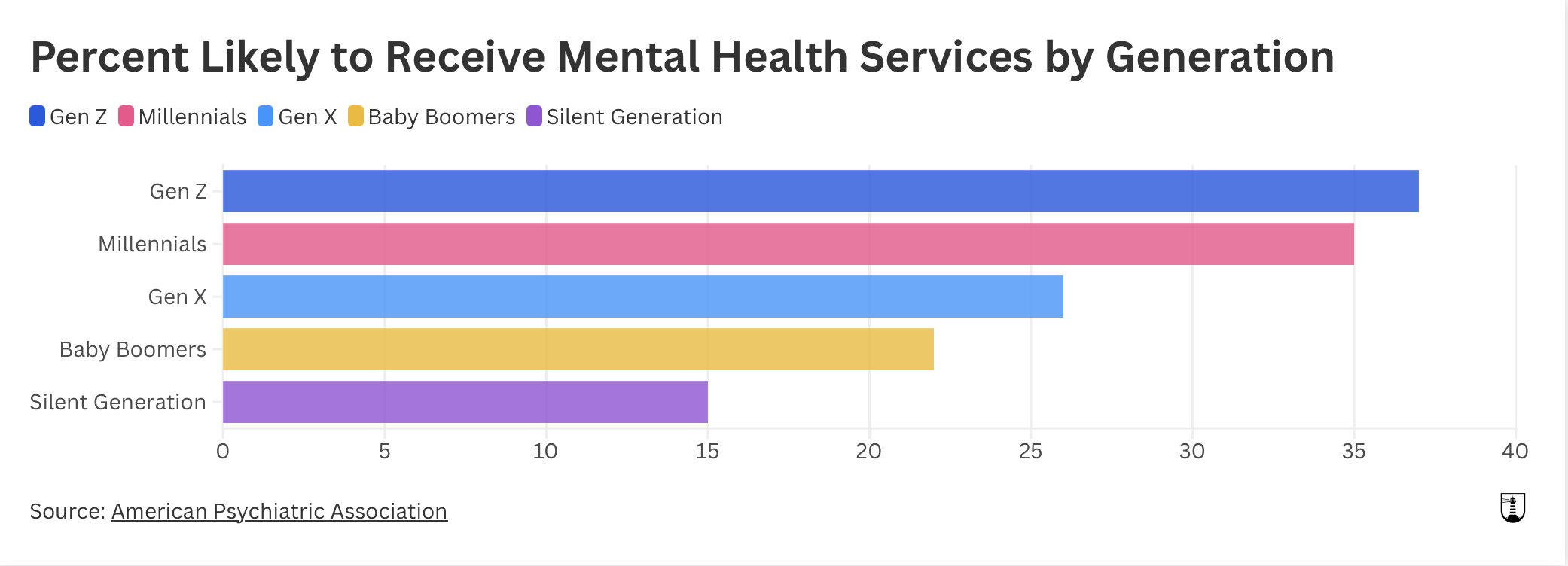
The American Psychiatric Association found Gen Z and Millennials were more likely to have received treatment or gone to therapy at 37% and 35% respectively compared to Gen X’ers at 26%, Baby Boomers at 22%, and the Silent Generation at 15%. We mental health know it’s real, and most of us agree it’s a serious concern. And that puts us far ahead of past generations.
Most of us grew up hearing the word ‘anxiety’ used in everyday conversation. We know the jargon: depression, burnout, intrusive thoughts. We throw those around every day, but knowing that you’re struggling doesn’t mean there’s anyone around to help.
Here’s the key problem: knowing the words doesn’t mean you know what to do with them. Mental health awareness has gone mainstream, but access hasn’t. The language is easier to find than the help.
We’re more likely to attend therapy, but that doesn’t mean there’s always a therapist or counselor available.
Especially in schools, where students are most likely to need it. Many schools have one counselor for hundreds of kids, and oftentimes that counselor’s also tracking truancy or covering lunch duty. Meanwhile, the academic pressure just keeps getting worse. College admissions only get more competitive, and it’s never been easier for students to compare themselves with others.
So, why is Gen Z so anxious? It’s not just the phones. Or the world. Or the pressure. It’s all of it, stacked. We’ve learned to name our feelings before we learned how to deal with them. And when things started to break at school, at home, or online, we’re told we’re too dramatic and to toughen up, and if we do want to reach out for help, oftentimes it's simply not available.
But here’s the part people miss: we’re not anxious because we’re weak. We’re anxious because we’ve been paying attention. And still, we show up. We joke. We try. Sometimes we overthink things.
But we’re not ignoring it. This generation didn’t ask for the mess, but we’re not waiting around for someone else to clean it up either.
If you want to help clean up the mess that is the current mental health climate in the United States, and you support mental health education, I ask that you join our cause to help educate our rural communities and join our newsletter. And as always, be a beacon of hope.
By Trace Ribble